You’ve probably been in a meeting where someone realises they’re supposed to be taking the minutes… while also trying to contribute, listen, and keep up. It’s not a job most people want.
So it’s no surprise that AI minute-taking tools have become an attractive option. Press record, let the software do its thing, and out comes a set of notes. I’ve used some myself to capture meeting notes, and they can be genuinely useful.
But there is a big difference between having notes from a meeting and having a set of minutes you can rely on.
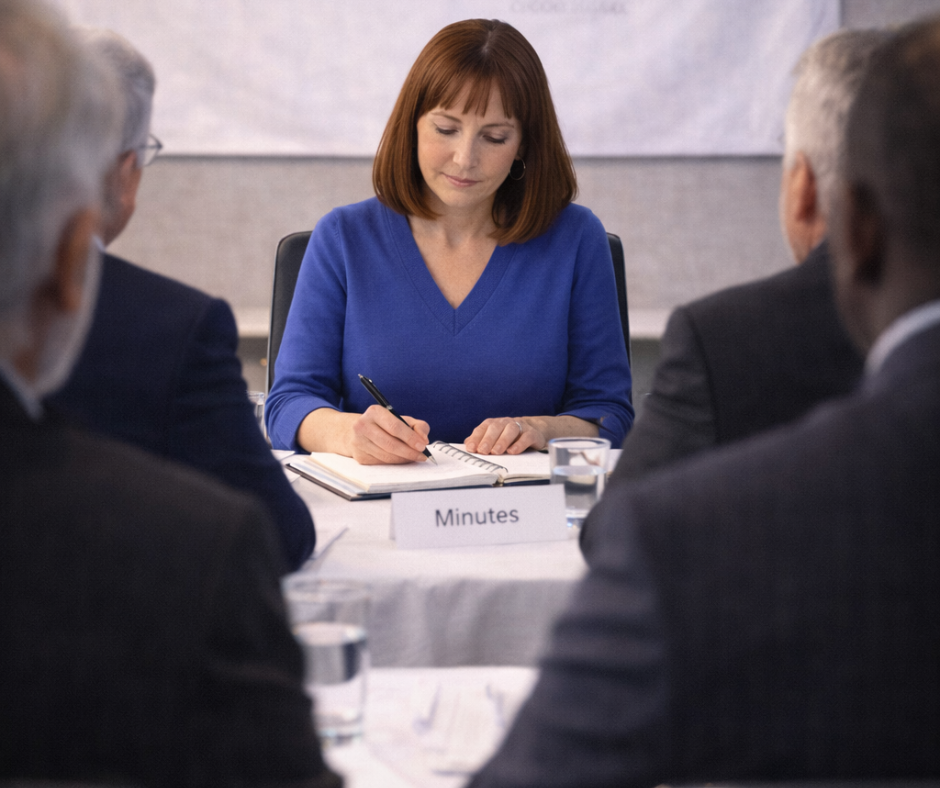
Minute-taking requires concentration, judgement, discretion, and the ability to follow a conversation while turning it into a clear, accurate record. It’s more than just writing things down. It’s active listening, filtering, and making decisions in real time. And the person taking the minutes can’t take part in the meeting either.
So it’s understandable that many organisations look to AI as a possible solution.
And in some cases, it works well.
This is not a question of AI vs humans. It’s about understanding where each fits, and being realistic about where they don’t.
The rise of AI in minute taking
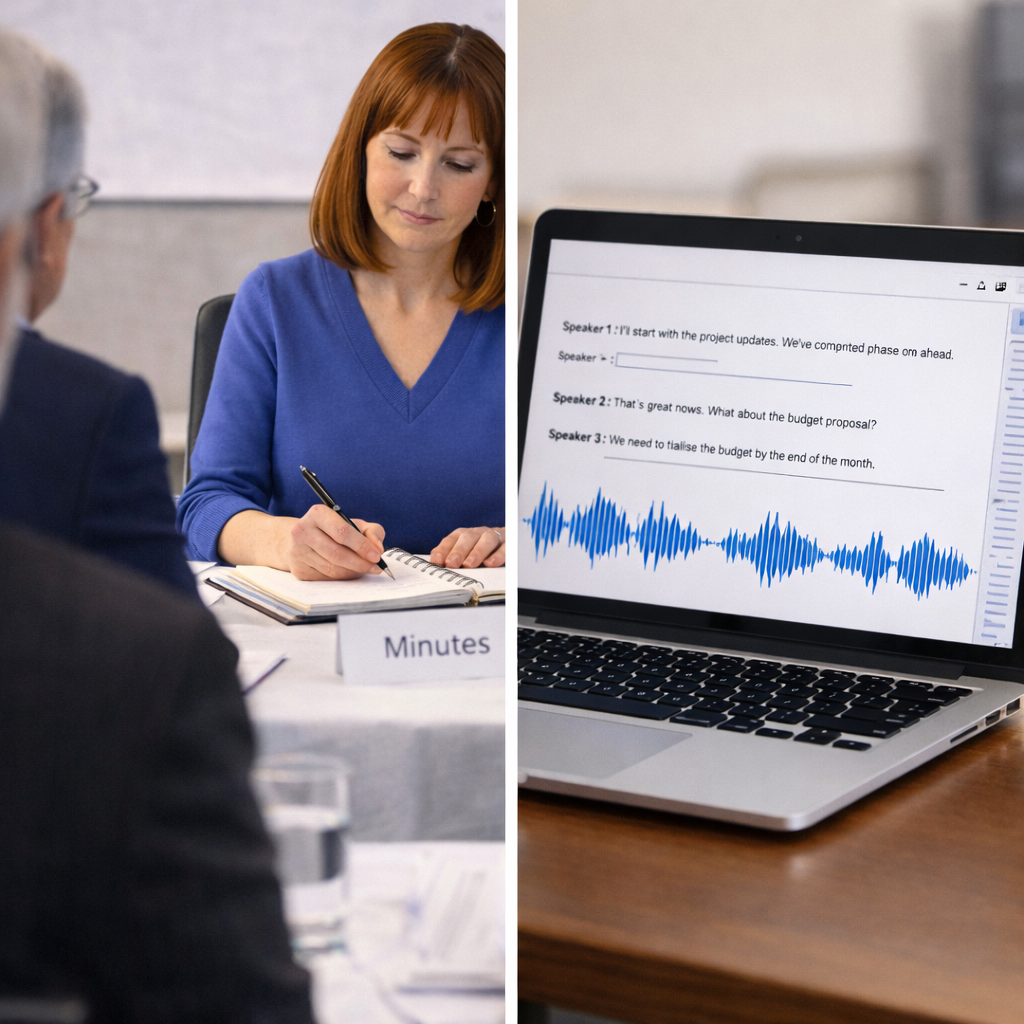
AI meeting tools have come a long way. They can transcribe meetings quickly, identify speakers (most of the time), and produce a summary within minutes.
For smaller, informal meetings, this can be very helpful.
Team catch-ups, internal updates, and project meetings often don’t need a perfectly structured, formal set of minutes. In these situations, a quick summary is often enough.
Used well, AI can save time and reduce the administrative load, leaving everyone free to participate in the meeting.
It absolutely has a place.
Where things become less straightforward
The challenges appear when meetings become more complex.
Not because the technology is poor, but because minute-taking at this level isn’t just about capturing words, it’s understanding what matters.
In governance, board, HR, disciplinary, and safeguarding meetings, the role of the minute taker changes completely.
It becomes about identifying what is material, recording decisions clearly, capturing actions accurately, and ensuring the language used is neutral, appropriate, and cannot be misinterpreted later.
AI can tell you what was said. It cannot tell you what should be recorded. And that distinction matters more than most people realise.
A question of accountability
In more formal settings, minutes are not simply a record of a conversation. They’re relied upon, referred back to, used to track decisions. They can sometimes form part of a formal or legal record too. That’s when accuracy and neutrality become critical, and the level of accountability increases significantly.
An experienced minute taker understands how to structure minutes properly, how to record decisions clearly, and when something needs to be clarified before it is written down.
They also know when not to include something. That judgement comes from experience, not software.
Sensitivity and confidentiality
And of course, there is also the human side to this.
Meetings involving HR issues, disciplinary matters, or safeguarding concerns are not just complex. They’re sensitive and highly confidential.
People are often speaking carefully, sometimes emotionally, and occasionally reluctantly.
The person recording that meeting needs to understand tone, context, and the importance of getting the language right.
They also need to handle the information with discretion.
While AI tools continue to improve, many organisations are understandably cautious about relying on them in these situations, particularly where confidentiality and data storage are a concern.
A real-world example
An organisation we work with opently told us that had already explored the use of AI before approaching us.
As they put it:
“Minute-taking in any environment is an arduous task that many shy away from. Golf Club Council and Committee meetings certainly fall into that scenario. We decided to try an AI tool as a solution, but in the end, it produced more problems than answers”.
The concept of a Virtual PA was introduced through our General Manager and S.A.M. Ltd was engaged to service the function. They have produced excellent meeting minutes with accurate content from the Zoom meetings or recordings of meetings, while always demonstrating total integrity.”
(Richard McDermott, Council Member and Links Convenor, Royal Portrush Golf Club, April 2026)
Their experience isn’t unusual. AI provided a starting point, but not a complete solution for the type of meetings they were running.
Finding the right balance
For many organisations, the most practical approach isn’t choosing one over the other but using both where they make sense.
AI works well for informal meetings, quick summaries, and early-stage note capture.
Human minute takers are better suited to board meetings, governance settings, committees, and anything involving HR or safeguarding.
In other words, the more important the meeting, the more important the judgement behind the minutes.
My final thoughts
AI is a useful tool, and its role will continue to grow.
But minute-taking, particularly in more formal or sensitive settings, still relies heavily on human judgement, experience, and integrity. I don’t see that changing any time soon.
The goal isn’t to replace one with the other, but to use each appropriately.
When that balance is right, you get the efficiency of technology without compromising on the quality and reliability of your records.
Sam Johnstone, April 2026