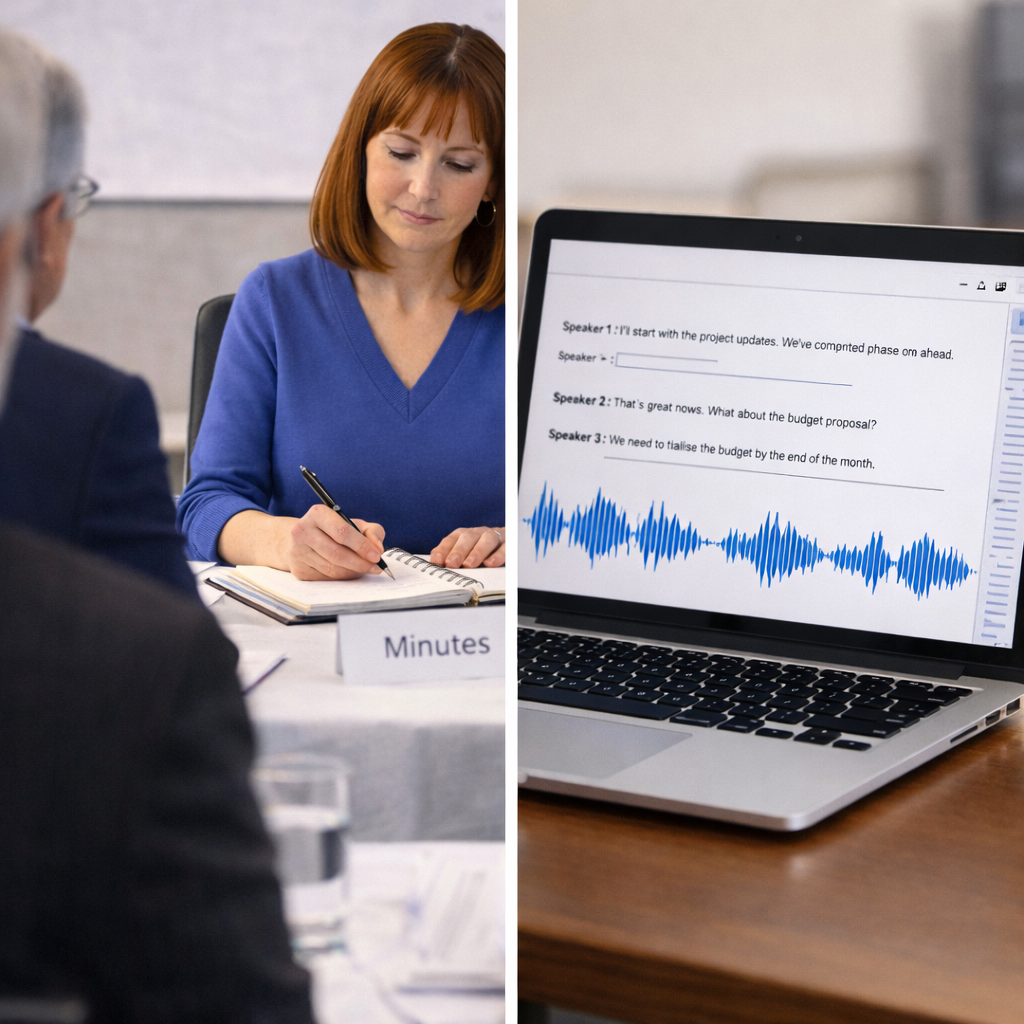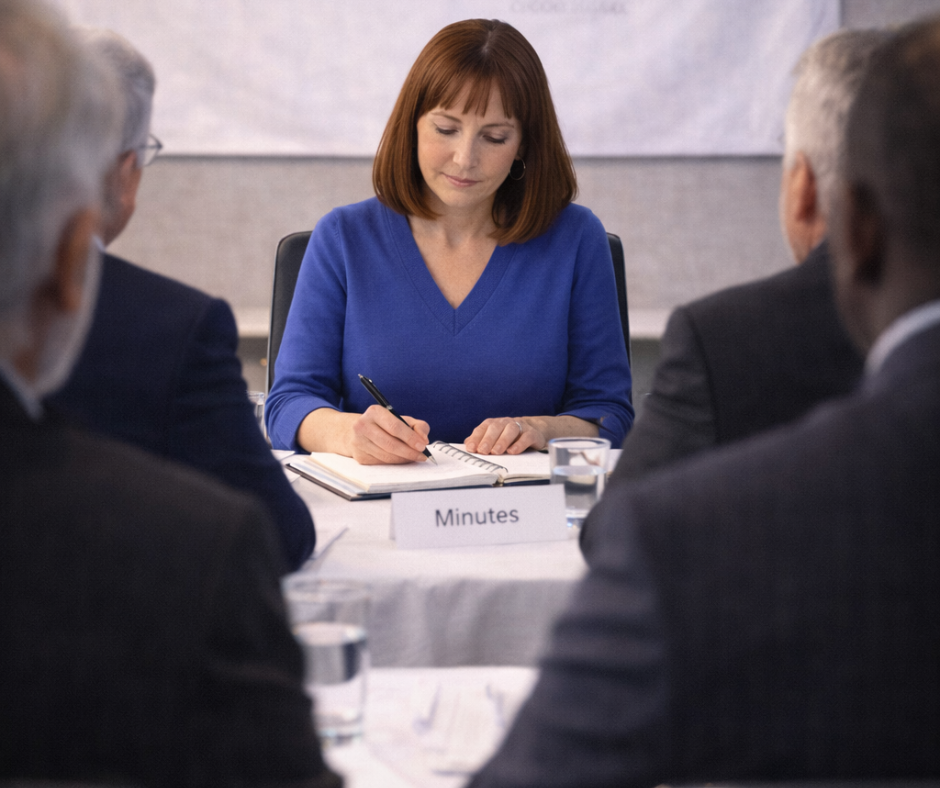
The AGM is the one meeting in the golf club calendar where the minutes will actually be read. Read by members. Read at appeal, if a contested election comes to that. Read by the auditors. Read by whoever takes the Secretary’s role in five years’ time and wants to understand how a particular rule change came about.
Most other meetings produce minutes that sit in a folder and are referenced once. AGM minutes are different. They are the formal record of the club’s governance for the year, and they have to hold up to scrutiny that no other meeting attracts.
This post is for Club Secretaries, General Managers and Honorary Secretaries at larger golf clubs who are looking at the AGM in the diary and thinking carefully about how it will be minuted.
Why golf club AGMs are technically demanding to minute
A board meeting follows a predictable rhythm. A small group, a circulated agenda, a Chair who runs the discussion in turn, and a minute taker who has often been doing the job for years.
The AGM is a different animal. Several things change at once.
The room is larger — sometimes substantially larger. Voices come from all corners. Members who haven’t spoken at a club meeting in a decade may rise to ask a pointed question about the accounts. The minute taker has to attribute speakers correctly without knowing every member by sight.
The agenda is longer and more formal. The Captain’s report. The Treasurer’s presentation of the accounts. The election of officers and council members. The proposing and seconding of resolutions. Motions from the floor. Any other business. Each of these has a procedural shape that the minute taker has to follow, not summarise.
The stakes attached to specific items are higher. A subscription increase that passes by a narrow margin. A rule change about playing rights. A resolution on capital expenditure. If the outcome is later disputed — and at heritage clubs, it sometimes is — the minutes are the document everyone returns to.
And the social texture of the meeting matters. Long-serving members have ways of speaking that are part of the club’s culture. Honorary positions carry weight. The Captain’s authority in the room is real even when it is exercised lightly. A minute taker who doesn’t understand this writes minutes that read as flat or, worse, slightly tone-deaf.
What good AGM minutes actually capture
The temptation, particularly with a longer meeting, is to summarise. To boil a forty-minute discussion of the proposed clubhouse refurbishment down to three sentences. For internal meetings, that’s often appropriate. For an AGM, it isn’t.
Good AGM minutes capture, at minimum:
- The exact wording of every motion as proposed and as amended
- The names of proposers and seconders for each resolution
- The voting outcome — for, against, abstentions where relevant, and whether the vote was by show of hands, by poll, or by a count of members present
- The full result of each contested election, with vote counts where the club’s rules require them recorded
- The substance of questions raised by members, with sufficient context that a reader two years later understands what was being asked
- The Chair’s responses to those questions, and any commitments made
- Any rulings made by the Chair on procedural points
- Apologies, attendance numbers (or quorum confirmation), and the time the meeting opened and closed
Notice how much of that is about exact wording. AGM minute-taking is closer to forensic capture than to discursive summary. A minute taker who is used to producing executive summaries of strategy meetings will instinctively compress where, at an AGM, they need to preserve.
What changes when an external minute taker handles your AGM
The first thing that changes is that the Secretary or General Manager can actually be present in the meeting as a participant rather than a recorder. At most clubs, the Secretary could be taking the minutes themselves or supervising a junior member of staff who is. Both arrangements are workable for routine meetings; neither is ideal for an AGM where the Secretary may need to speak, advise the Chair, or handle a procedural query from the floor.
The second thing that changes is consistency of format. An external minute taker who handles multiple clubs’ AGMs brings a settled template — one that handles motions, elections, member questions and Chair’s rulings in a way that auditors recognise and that future Secretaries can navigate. Internal minute-taking often drifts in format from year to year as different people take the work on.
The third thing that changes is turnaround. A draft within two to three working days of the meeting, while the room is still fresh in everyone’s memory, makes the Chair’s review materially easier. AGM minutes that arrive six weeks later — which happens more often than clubs would like to admit — are harder to verify and harder to defend if challenged.
The fourth thing is the quiet professionalism of the arrangement. An experienced external minute taker is in the room or on the call, takes the work seriously, leaves with the recordings and notes, and returns a clean draft. They don’t need briefing on what an AGM is for, what a quorum is, or why the order of business matters.
How it works in practice at a heritage club
There is sometimes a concern, particularly at older clubs, that bringing in an external minute taker will sit uncomfortably with the club’s culture. In practice, the opposite tends to be true. Members notice when the AGM is well-run. The minutes that go out afterwards reflect on the Council and the Captain — and well-produced minutes are one of the strongest signals of a well-run club.
The minute taker is briefed in advance on the agenda, the club’s constitution or rule book, the names and roles of the officers, and any items expected to attract significant discussion. On the day, they join the meeting in person or by video link, take the working notes and (with permission) a recording, and produce the draft for the Secretary and Chair to review. Once approved, the minutes are circulated in the usual way.
We currently do this work for Royal Portrush Golf Club, where Richard McDermott, Council Member and Links Convenor, has been kind enough to say publicly that he would have no hesitation in recommending us for the work. The arrangement at Portrush began after the club tried an AI minute-taking tool that, in their words, produced more problems than answers. That experience is not unusual.
What to ask any provider before commissioning
Four questions are worth putting to anyone you’re considering for AGM work.
First, have you minuted an AGM before, and ideally one at a club or membership organisation of similar character to ours? Board-meeting experience is not the same thing.
Second, what is your turnaround time for the draft, and what does the review process look like? Two to three working days is achievable. Two to three weeks is not good enough for an AGM.
Third, how do you handle elections, resolutions and motions from the floor procedurally? The answer should come quickly and confidently. If it doesn’t, the provider is improvising.
Fourth, what does the engagement look like for the AGM specifically — one-off project, or part of a wider arrangement covering Council and Committee meetings through the year? Many clubs find that the AGM is the gateway to a fuller retainer once the quality of the work is visible.
A practical note on timing
AGM season at UK and Irish golf clubs clusters heavily between January and April, with a smaller second cluster in October and November. If your AGM is in that window, the conversation worth having is in the preceding quarter, not the preceding month. Minute takers worth using book up early in the season.
How S.A.M Ltd works with golf clubs
We provide minute-taking and Co-Sec support for golf clubs on an annual retainer basis, typically covering Council meetings, Committee meetings, and the AGM. We also take on AGMs as standalone projects where a club wants to trial the arrangement before committing.
The minute taker who attends has direct experience of Royal golf club AGMs and Council meetings, understands governance and the rule book context, and turns drafts around within two to three working days.
If your AGM is in the diary — confirmed or provisional — a short conversation will tell you whether the arrangement would suit your club.