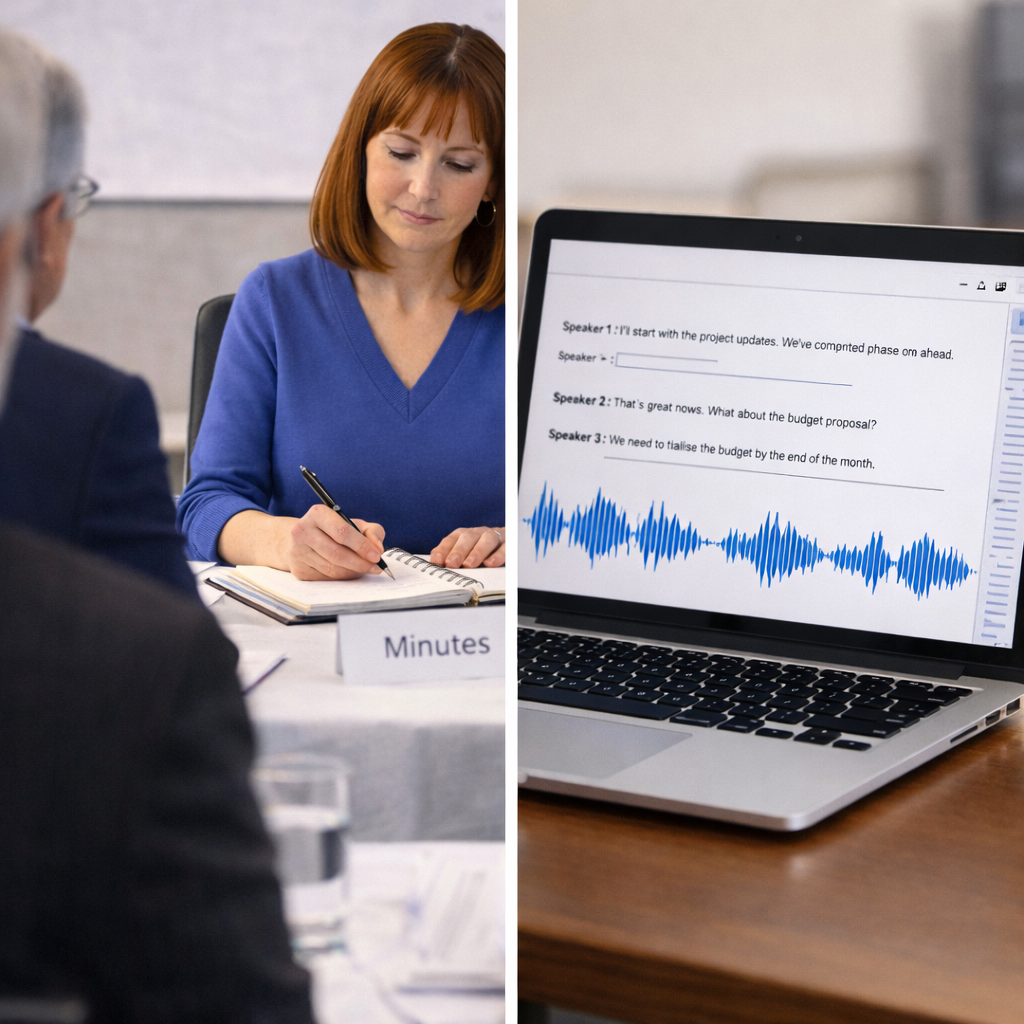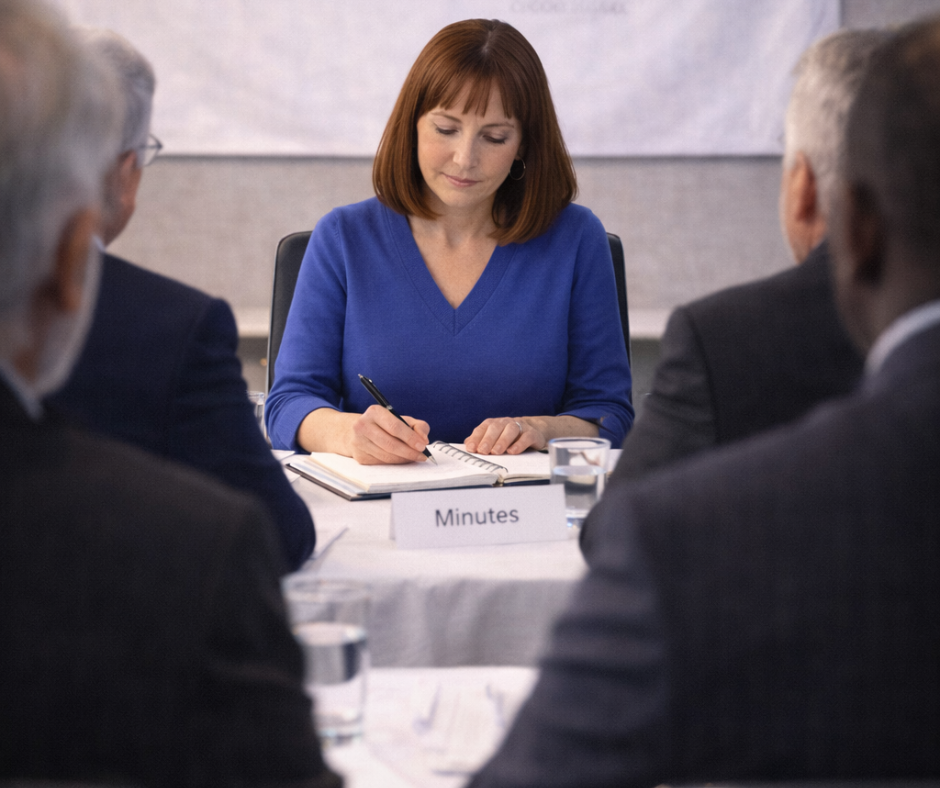
There is a particular kind of meeting that most organisations would rather not hold. A grievance has been raised. A member’s conduct is under review. A safeguarding concern has reached the panel stage. The agenda is short, the room is quiet, and every word said in it matters more than usual.
These meetings need minutes. They almost always need better minutes than the organisation’s usual practice produces. And they very often need someone in the room — or on the call — who is not part of the organisation at all.
This post is for Chairs, CEOs, HR leads and General Managers who are looking at a sensitive meeting on next month’s calendar and wondering who is going to write it up.
Why your usual minute taker may not be the right choice
In most organisations, minutes are taken by whoever is closest to the work. A board secretary. An office manager. A long-serving volunteer. For routine meetings, that arrangement works perfectly well.
Sensitive meetings change the calculation, and three things shift at once.
The first is proximity. Your usual minute taker probably knows the people involved. They may have worked with the employee whose conduct is being examined, or sat on committees with the trustee whose behaviour has been challenged. That familiarity is ordinarily an asset. In a disciplinary or grievance setting, it becomes a liability — both for the minute taker, who is placed in an uncomfortable position, and for the integrity of the record, which can later be challenged on grounds of bias.
The second is technical demand. Sensitive meetings move differently from board meetings. There are pauses for legal advice. There are adjournments. There are moments where the precise wording of an allegation, a response, or a question matters enormously, and where paraphrase will not do. A minute taker who is used to capturing the gist of a strategy discussion is not necessarily equipped for the forensic capture these meetings require.
The third is confidentiality at scale. The minute taker hears everything. In a sensitive meeting, “everything” includes information that should not circulate inside the organisation under any circumstances — and your in-house minute taker has to go back to their desk, surrounded by colleagues, holding all of it.
What “independent” actually means in this context
When we talk about an independent minute taker, we mean someone who:
- has no prior or ongoing relationship with any party in the meeting
- is not employed by, or a member of, the organisation
- has no stake in the outcome
- is bound by a written confidentiality agreement and works to GDPR-compliant handling standards
- can later, if needed, give a credible account of the process by which the minutes were produced
That last point is the one most organisations underestimate. If a disciplinary outcome is challenged — at appeal, at tribunal, at a regulator — the question that follows is rarely what do the minutes say? It is how were the minutes produced, by whom, and on what basis? An independent minute taker gives you a clean answer to that question.
What changes in the room (or on the call)
A minute taker experienced in sensitive meetings does several things differently.
They capture direct speech at key moments rather than paraphrasing — particularly when an allegation is put, when a response is given, and when the Chair states a decision. They note adjournments with timings, who left the room, and what was discussed informally afterwards if anything. They track questions asked but not answered, because that pattern often matters later. They are alert to points of clarification, prompting the Chair if a critical statement was unclear, rather than guessing.
They also know what not to write down. Off-the-record asides, emotional reactions that aren’t substantive, side conversations during a break — these don’t belong in the formal record, and an experienced hand knows the difference.
Afterwards, the draft comes back quickly — typically within two to three working days — and it comes back tidy. Speakers are correctly attributed. Decisions are clearly recorded. Action points are unambiguous about who is doing what by when. The Chair reviews, signs off, and the record is closed.
When organisations typically reach for an independent minute taker
The pattern we see is consistent. Organisations bring in an external minute taker when one or more of the following is true:
- A grievance, disciplinary or safeguarding panel is convening, and the usual minute taker is conflicted, too junior, or emotionally close to the matter
- A member-conduct hearing or fitness-to-practise process is being run by a club, charity or professional body
- An appeal is anticipated, and the organisation wants the minute-taking process itself to be unimpeachable
- A previous internal minute-taking attempt has been challenged, and the organisation needs a clean restart
- Legal advisors have specifically recommended an external record-keeper
What these scenarios share is a common feature: the cost of poor minutes is far higher than the cost of good ones. A disciplinary outcome overturned on procedural grounds, or a grievance reopened because the record was disputed, is an expensive problem. An independent minute taker is, in that context, a small piece of insurance.
What to look for when commissioning one
If you are scoping this work for the first time, four questions are worth asking any provider:
- Has the person who will actually be in the meeting taken minutes for grievance, disciplinary or comparable sensitive proceedings before? Experience in board meetings is not the same thing.
- What is the turnaround time for the draft, and what does the review process look like?
- How are the working notes and final minutes stored, transmitted and eventually destroyed? GDPR matters here, and so does the practical question of where the audio recording (if there is one) lives.
- Who signs the confidentiality agreement, and what does it cover?
The answers will tell you quickly whether the provider has done this kind of work before or is improvising on the day.
A practical note on timing
Sensitive meetings tend to be commissioned at short notice. Diaries clear. The meeting that wasn’t going to happen until late next month is suddenly happening on Friday week. If you are reading this with a meeting already in the diary, the most useful thing you can do is have the conversation with a provider now, even if the meeting date later moves. Independent minute takers worth using tend to be booked, and a held slot is easier to release than a slot that didn’t exist in the first place.
How S.A.M Ltd works on these meetings
We provide independent minute-taking for sensitive meetings on a project basis or as part of a wider retainer. The minute taker who attends has direct experience of disciplinary and grievance proceedings, works to written confidentiality terms, and turns drafts around within two to three working days.
If you have a sensitive meeting coming up — confirmed or only provisional — a short, no-obligation conversation will tell you whether we are the right fit and what the practical arrangements would look like.
Book a 30-minute discovery call → Speak to Sam